I’ve always found it interesting that tarot readers are perfectly happy to stare at Death, The Tower, or a card depicting someone pierced by ten swords, but the moment a deck includes nudity, people get nervous.
That tension sits at the heart of Eros Tarot.
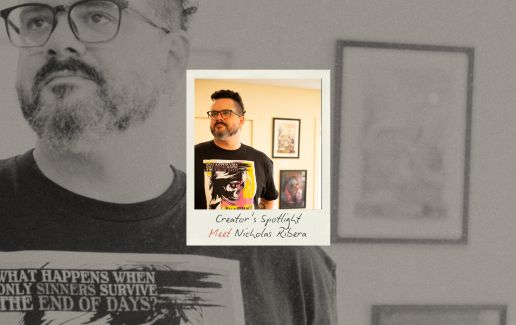
Created by Nicholas Ribera, the deck is now entering its third edition, more than five years after it first launched during the pandemic. Looking back, Ribera’s introduction to tarot was surprisingly recent. A friend showed him a collection of decks, opening his eyes to the fact that tarot could be more than the traditional Rider-Waite-Smith imagery.
“I had no idea that there was more than the traditional tarot,” he says. “That you can create themes, do your own art, or even make up your own cards.”
At the time, he was already producing a lot of erotic artwork. Locked down like everyone else, he was looking for a large creative project. An erotic tarot deck felt like a natural fit.
What began as a passion project has since become one of the defining works in his growing publishing catalogue.
Ribera is still proud of the original artwork, but Eros Tarot’s third edition reflects how much he’s learned since those early days. Alongside his partner, Leslie Haas, who now handles much of the marketing and logistics, he has become more deliberate about how a deck functions as a complete object.
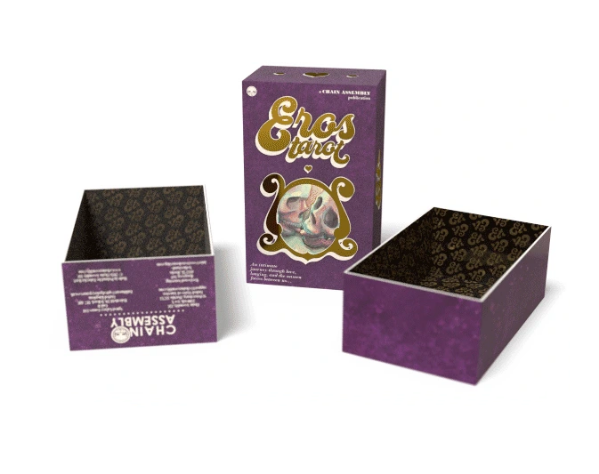
The new edition draws inspiration from 1970s paperback romance novels, a notable shift from the first edition’s packaging.
“The first edition’s box and guidebook was a glowy mess of abstracted body parts,” he laughs. “Pretty, but didn’t really match with the calming aesthetic of the card art.”
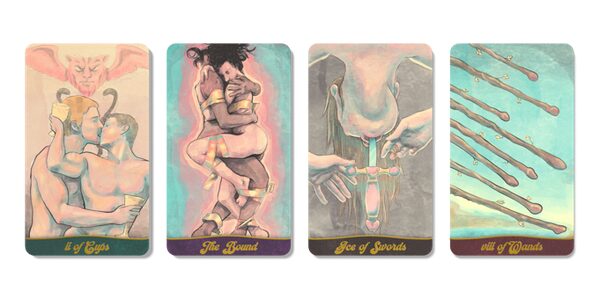
One of the things I appreciate about Eros Tarot is that the nudity rarely feels gratuitous. Sex is the language of the deck, but it is not always the subject.
Take The Tower.
It was the first card Ribera illustrated and originally stemmed from an attempt to connect the Major Arcana with positions from the Kama Sutra. That idea quickly fell apart, but the card remained. Instead of depicting explosive destruction, his Tower shows a couple embracing.
Look closer, however, and something feels off.
“They don’t make eye contact,” he explains. “Their gaze and minds are elsewhere.”
For Ribera, the card represents break-up sex. The quiet intimacy that arrives at the end of a relationship. A moment that should feel close but instead feels routine, detached, almost clinical.
“It’s the ending of a relationship. A quiet scene in a disastrous end.”
That approach runs throughout the deck. Desire is present, but so are power, vulnerability, communication, loneliness, trust, and failure.
I mentioned in an earlier article that I was drawn to The Emperor and had to mention to Ribera about it.
“I wanted the Emperor to work as an inversion of the Empress,” he says.
Both cards depict naked rulers surrounded by attendants.
“They are seated in positions of power. They are naked, but not vulnerable. They stare at the viewer, challenging them.”
The inspiration came partly from Spartacus, specifically a scene involving the slave-owning couple Batiatus and Lucretia using their servants as foreplay before retiring together.
“It was strange imagery that stuck with me.”
That willingness to engage with uncomfortable ideas extends beyond the cards themselves.
When Eros Tarot first went into production, Ribera encountered an obstacle that many creators of erotic art know well. The Chinese factory printing the deck informed him that their freight forwarding partner refused to transport the product because of its nudity. He eventually found another shipping company, albeit at a higher cost. Later, the same factory declined to print the second edition altogether.
What frustrated him was the contrast.
The factory had no issue printing The Goracle, his subsequent oracle deck filled with violence, death, and gore.
“It’s interesting,” he reflects. “People talk about America being puritanical, but other countries can be much stricter.”
His explanation for society’s discomfort with erotic imagery is blunt.
“I think it all comes down to men being predators,” he says. “The idea that a man can be driven so mad with lust that he is not responsible for his own actions is prevalent throughout history and literature.”
It is a perspective that sits beneath much of the deck’s exploration of consent, power, and desire.
Not that Eros Tarot avoids provocation.
The card Ribera considers most shocking is The Chariot, which depicts one man riding another while holding reins around his partner’s neck.
“It’s very sexy, but very dangerous,” he says. “I hope both of them are okay.”
The image has attracted plenty of attention over the years, including one admirer who apparently asked if Ribera would like to recreate the scene with him.
“I took that as a seal of approval.”
The newest edition pushes things even further with the inclusion of five additional Major Arcana cards inspired by The Goracle. One of them, The Penetrated, depicts a woman performing oral sex on a man while simultaneously penetrating him with a strap-on.
The image is deliberately confronting.
Yet Ribera is careful to distinguish between shock value and storytelling.
“Thematically, it serves a purpose,” he says. The card functions as a marker of beginnings and endings depending on its orientation within a reading.
The image may be provocative, but it still serves the system.
Perhaps that is why Eros Tarot has endured beyond novelty.
Readers do not seem to be treating it as a joke or a curiosity. Many have incorporated it into their relationships. Ribera has heard from couples who use the deck as part of foreplay, or as a way to build emotional intimacy through shared readings.
“I love the idea that couples are growing closer together as they read for each other and explore my art.”
Working on the deck has influenced his own relationship as well. Ribera and Haas modelled for some of the photographic references used throughout the cards.

“Watching her describe the project to people in the same earnest, matter-of-fact style that I do is heartening,” he says. “It shows that we’re open and honest about our own sexual communication.”
That openness extends to his broader creative philosophy. After several successful Kickstarter campaigns, he has become increasingly willing to pursue niche ideas.
“The more specific I make a project and the more it leans into what interests me, the more likely my supporters are to come out and be part of it.”
It is advice he shares with aspiring creators too. Build your audience early. Launch your Kickstarter page long before launch day. Give people time to find it.
“The best time to start is now.”
As for what comes next, Ribera remains fascinated by communication, intimacy, and the ways people connect through play. He still hopes to revisit Satisfy, a board game designed to help couples improve sexual communication, a project he remains proud of despite its commercial struggles.
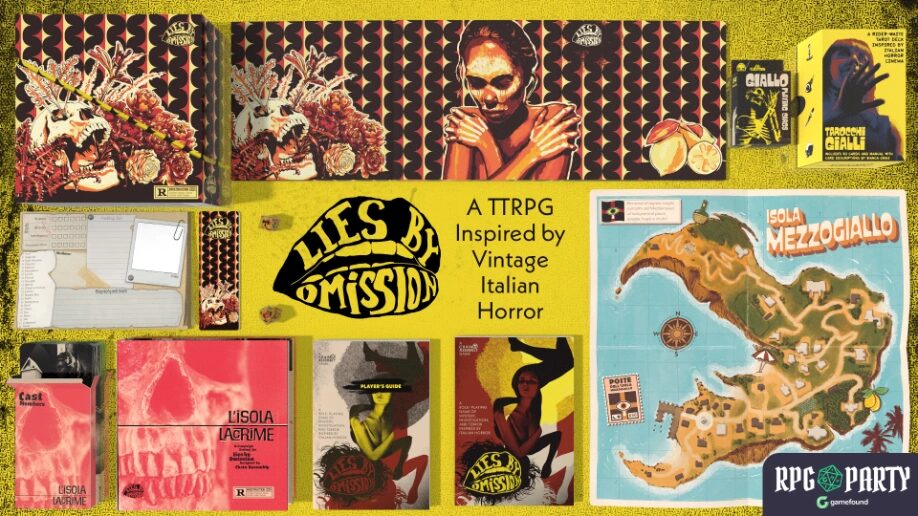
Meanwhile, his attention is increasingly turning towards tabletop roleplaying games, particularly Lies By Omission, which uses tarot rather than dice to resolve outcomes.
The Eros Tarot will be available for late pledges, visit the campaign’s Kickstarter page for more information. You can also visit their Instagram account for the latest news.
Leave a Reply